
Piston, Gravity or Pump Filling: Which Technology Suits Your Pharma Syrup?
Compare piston, gravity, and pump filling technologies for pharmaceutical syrups, suspensions, and liquid medicines. Discover their advantages, accuracy, cleaning requirements, and how to choose the right pharma liquid filling machine for your production needs.
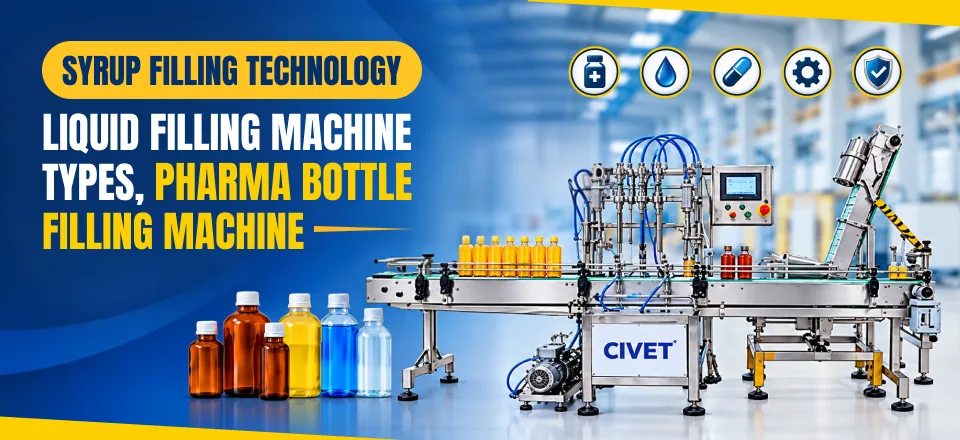
When a pharma manufacturer asks for a “liquid filling machine”, the first technical question a good supplier will ask back is: what does your product behave like? A thin cough syrup, a thick antacid suspension and a foaming tonic each need a different filling approach. Choosing the wrong filling technology leads to inaccurate doses, dripping nozzles, foaming and wasted product. This guide compares the three most common technologies, piston, gravity and pump filling, so you can choose the right one for your liquid oral products.
Why Filling Technology Matters in Pharma
In pharmaceuticals, every bottle must contain the declared volume. Underfilling risks regulatory problems and patient complaints. Overfilling gives away expensive product and adds up to large losses over a year. Beyond accuracy, the filling system must also be hygienic, easy to clean between batches, and reliable across long production runs.
1. Piston Filling
How It Works
A piston draws a fixed volume of liquid from a hopper into a cylinder, then pushes that exact volume out through a nozzle into the bottle. The stroke length of the piston sets the fill volume.
Best For
- Medium to high viscosity liquids: suspensions, antacids, thick syrups
- Products where volumetric accuracy is the top priority
- A wide range of fill volumes
Advantages
- High volumetric accuracy, since each stroke displaces the same volume
- Handles thick products that will not flow under gravity
- Fill volume is easy to adjust
Points to Consider
- More moving parts in contact with the product, so cleaning takes more care
- Seals wear over time and need replacement as part of maintenance
2. Gravity Filling
How It Works
- Liquid is held in an overhead tank. When a bottle is in position, a valve opens and the liquid
- flows down by gravity. Filling is controlled either by time (timed gravity filling) or by level.
Best For
- Thin, free-flowing liquids with consistent viscosity
- Products that should be handled gently
Advantages
- Simple design with few moving parts
- Easy to clean
- Gentle on the product
Points to Consider
- Not suitable for thick products
- Accuracy depends on keeping the tank level and product temperature stable, since
- viscosity changes with temperature
3. Pump Filling
How It Works
A pump (for example a gear, lobe or peristaltic pump) moves the liquid from a tank into the bottle. The fill volume is controlled by pump rotation or run time.
Best For
- A range of viscosities, from thin to moderately thick
- Products where quick changeovers are needed
- Small batches and multiple products (especially with peristaltic pumps, where only the tubing touches the product)
Advantages
- Flexible across products
- Peristaltic designs allow fast, hygienic product changes by swapping tubing
Points to Consider
• Pump and tubing selection must match your product
• Tubing is a consumable that needs regular replacement
Quick Comparison
| Comparison Factor | Piston Filling | Gravity Filling | Pump Filling |
|---|---|---|---|
| Thin Syrups | Good | Very Good | Very Good |
| Thick Suspensions | Very Good | Not Suitable | Good (with the right pump) |
| Volumetric Accuracy | Very High | Good (if conditions are stable) | High |
| Cleaning Effort | Moderate | Low | Low to Moderate |
| Product Changeover | Moderate | Easy | Easy (especially peristaltic) |
| Foaming Products | Good with bottom-up nozzles | Fair | Good with flow control |
Handling Foaming Products
Some tonics and herbal syrups foam when filled quickly. Foam makes the bottle look underfilled and can overflow onto the neck, causing problems at capping. Solutions include:
- Diving nozzles that fill from the bottom of the bottle upwards
- Slower fill speeds at the start and end of each fill
- Anti-drip nozzles to keep the bottle neck clean
Beyond the Filler: Building a Complete Line
A pharma liquid filling machine is rarely used alone. A typical liquid oral line includes:
- Bottle feeding (manual table or unscrambler)
- Filling
- Capping (ROPP or screw caps)
- Automatic sticker labelling
- Batch coding
- Inspection and packing
Matching the speed of each machine avoids bottlenecks and keeps the line running smoothly.
Questions to Ask Your Supplier
- Can you run a trial with our actual product?
- Which grade of stainless steel is used for contact parts?
- How long does a full clean and changeover take?
- What is the fill accuracy at our bottle volumes?
- Which parts are consumables, and are spares available locally?
- Do you provide installation, operator training and an AMC?
Civet India Liquid Filling Lines for Pharma
Civet India builds liquid filling, capping and labelling lines for syrups, tonics and liquid medicines, customised to your bottle sizes and product. We help you select the right filling technology for your product, install the line at your site and train your operators. As an ISO 9001:2015 certified manufacturer based in Kolkata, we support pharma units across India with a 12-month warranty, 24/7 service and genuine spares.
Frequently Asked Questions
Which filling machine is best for cough syrup?
Thin, consistent syrups are often filled with gravity or pump systems, while thicker syrups may need a piston filler. A product trial is the best way to decide.
Can one machine fill both syrup and suspension?
Sometimes, depending on the filling
system. Share both products with us so we can advise.
How often should piston seals be replaced?
It depends on product and run hours. Your supplier should give a preventive maintenance schedule
Talk to a Filling Expert
Not sure which technology fits your product? Call or WhatsApp +91 8334957009 or visit civetindia.com to discuss a trial.