
Mineral Water Plant Machinery List: Every Machine You Need, from RO to Shrink Pack (2027 Guide)
Discover the complete mineral water plant machinery list, from RO water treatment and UV sterilisation to bottle filling, labelling and shrink packing. Learn how to choose the right 40 BPM or 60 BPM water bottling machine for your plant.
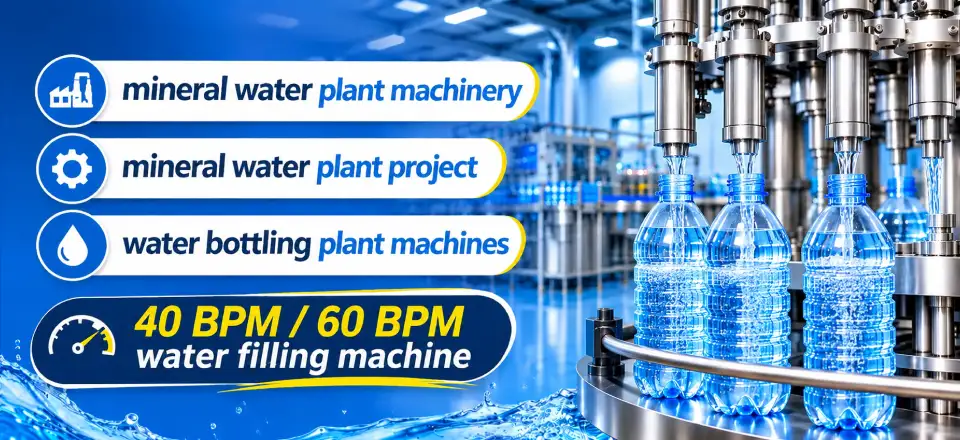
A mineral water plant needs two groups of machines. The water treatment section cleans the water: raw water tank, sand and carbon filters, softener, RO, UV and ozonation. The bottling section packs it: a filling machine (rinse-fill-cap or overflow filler), batch coder, labelling machine, shrink packing machine and conveyors. Below, we go through all the mineral water plant machinery one machine at a time. For each one we explain what it does, what to look for and how to choose the right capacity. We also include a full table you can take to any supplier. This guide is for firsttime water plant owners and investors, especially in Tier-2 and Tier-3 towns where demand for packaged drinking water keeps growing every summer.
Mineral water plant machinery list at a glance
Here is the complete list in one table. Each machine is explained in the sections that follow.
| Machine | What it does | Section | |
|---|---|---|---|
| 1 | Raw water storage tank | Stores borewell or municipal water before treatment. | Treatment |
| 2 | Raw water pump | Moves water through the treatment train at steady pressure. | Treatment |
| 3 | Chlorine / antiscalant dosing system | Kills bacteria and protects the RO membranes from scale. | Treatment |
| 4 | Pressure sand filter | Removes mud, sand and suspended particles. | Treatment |
| 5 | Activated carbon filter | Removes chlorine, odour, colour and organic matter. | Treatment |
| 6 | Water softener (if needed) | Reduces hardness that can damage RO membranes. | Treatment |
| 7 | Micron cartridge filter | Provides final fine filtration before the RO system. | Treatment |
| 8 | Reverse osmosis (RO) system | Removes dissolved salts (TDS), heavy metals and most impurities. | Treatment |
| 9 | Mineral dosing system | Adds back approved minerals for taste. | Treatment |
| 10 | UV steriliser | Kills bacteria and viruses without chemicals. | Treatment |
| 11 | Ozone generator and contact tank | Provides final disinfection so water stays safe in the bottle. | Treatment |
| 12 | Treated water storage tank (SS) | Holds clean water ready for filling. | Treatment |
| 13 | Bottle filling machine (rinse-fill-cap or overflow filler) | Rinses, fills and caps the bottles. | Bottling |
| 14 | Batch coding printer | Prints batch number, date and MRP. | Bottling |
| 15 | Sticker labelling machine | Applies the brand label. | Bottling |
| 16 | Shrink wrapping machine (web sealer with shrink tunnel) | Packs bottles into tight, shrink-wrapped multipacks. | Packing |
| 17 | Conveyors | Link every machine into one continuous production line. | Bottling / Packing |
| 18 | Quality control lab | Supports in-house testing for BIS certification. | Quality |
Part 1: The water treatment section
Raw water tank and pump
Your water comes from a borewell, a municipal supply or a tanker. It goes into a raw water tank first. A pump then pushes it through the treatment stages at a steady pressure. Size the tank to hold at least a few hours of production, so a short break in supply does not stop your line.
Dosing system
A small dosing pump adds a measured amount of chlorine to kill bacteria in the raw water. A second doser often adds antiscalant, which protects the RO membranes from scaling. Both chemicals are removed later in the process.
Pressure sand filter and activated carbon filter
The pressure sand filter traps mud, sand and suspended particles. The activated carbon filter comes next. It removes the chlorine added earlier, along with bad smells, colour and organic matter. Carbon protects the RO membranes, because chlorine damages them.
Softener (only if your water is hard)
If your raw water is very hard, a softener removes calcium and magnesium before the RO. Get your raw water tested first. The test report tells you whether you need a softener and how large it should be.
Micron cartridge filter
This is the last safety filter before the RO. It catches fine particles that slipped through the sand and carbon filters.
Reverse osmosis (RO) system
The RO system is the heart of the treatment section. High pressure pushes water through membranes that remove most dissolved salts, heavy metals and impurities. RO capacity is measured in litres per hour (LPH). Choose an RO that produces more treated water per hour than your filling machine can bottle, so the filler never waits for water. Many plants keep 20 to 30 percent extra.
Mineral dosing
RO water can taste flat. A mineral dosing system adds back approved minerals in controlled amounts, so the water tastes the way your customers expect.
UV steriliser and ozone generator
The UV steriliser kills bacteria and viruses using ultraviolet light. The ozone generator adds a small, controlled dose of ozone just before filling. Ozone keeps the water sterile inside the sealed bottle, then slowly turns back into oxygen.
Treated water storage tank
Treated water is stored in a stainless steel tank and fed straight to the filling machine. Food-grade stainless steel is the norm here because it is easy to clean and does not affect taste.
Part 2: The bottling and packing section
The filling machine is the most important purchase in your bottling section. There are two common types in Indian water plants.
1. Rinse-Fill-Cap (RFC) machine
One machine does three jobs. It rinses each bottle, fills it with treated water and screws on the cap. This saves floor space and labour, and the bottle is never touched by hand between rinsing and capping. If you want a step-by-step look inside one, read our guide on how a rinse-fill-cap water filling machine works. Civet India’s 60 BPM Packaged Drinking Water Filling Machine (RFC) is an automatic 12-head counter-pressure rinse-fill-cap machine for 1000 ml PET bottles. It produces 3,600 bottles per hour.
2. Overflow filling machine
An overflow filler brings every bottle to the same visible fill level, which looks neat and consistent on a shop shelf. It suits new and mid-size plants. Civet India’s 40 BPM Mineral Water Filling Machine is an automatic overflow filler that produces 2,400 bottles per hour. It handles 1000 ml PET, HDPE and glass bottles.
Batch coding printer
Every bottle must carry a batch number, manufacturing date, best-before date and MRP. An inkjet batch coder prints these details as the bottle passes on the conveyor. It is a legal requirement, so don’t plan to do it by hand.
Sticker labelling machine
Hand labelling looks uneven and slows the line down. An automatic labeller puts every label in the same place, straight and smooth.
Civet India’s Automatic Sticker Labeling Machine labels round bottles in plastic, glass, PET and aluminium. It applies up to 60 labels per minute using a stepper motor, with a PLC and touch-screen controls. That speed matches a 60 BPM filling line.
Shrink wrapping machine
Most water is sold to distributors in shrink-wrapped packs of 12 or more bottles. Shrink packs are tight, tamper-evident and easy to stack and carry.
Civet India’s Automatic Web Sealer with Shrink Tunnel seals the bottles in heat-shrinkable film and shrinks it tight in one line. It has a stainless steel body and a 1.5 kW three-phase drive.
Conveyors
Conveyors connect the filling machine, coder, labeller and shrink packer into one continuous line. Plan their length and layout together with the machines, not as an afterthought. A badly planned conveyor is one of the most common causes of bottlenecks.
Part 3: The quality control lab
To sell packaged drinking water in India you need BIS certification: IS 14543 for packaged drinking water, or IS 13428 for natural mineral water. You also need an FSSAI licence. BIS requires an in-house laboratory that can test your water and finished bottles. Lab equipment is part of your machinery budget, so include it from day one. A licensing consultant or your BIS application will give you the exact list of lab equipment and tests.
How to choose the right capacity: 40 BPM or 60 BPM?
| Parameter | 40 BPM Overflow Filler | 60 BPM Rinse-Fill-Cap |
|---|---|---|
| Bottles per hour | 2,400 | 3,600 |
| Bottles per 8-hour shift | About 19,200 | About 28,800 |
| Cases of 12 per shift | About 1,600 | About 2,400 |
| Bottle size | 1000 ml | 1000 ml |
| Bottle types | PET, HDPE, Glass | PET |
| Best for | New plants, local brands, glass bottles | Growing plants, distributor supply across districts |
A simple mineral water plant layout
A good layout moves water and bottles in one direction, with no backtracking:
Raw water tank → treatment room (filters, RO, UV, ozone) → treated water tank → filling room (filler) → coding → labelling → shrink packing → finished goods store → dispatch
Keep the filling room separate and clean, with controlled entry, washable walls and floors, and good lighting. Keep raw materials (empty bottles, caps, film) in a separate store close to the filling room, but not inside it.
Sample floor layout of a small mineral water plant with treatment room, filling room and store.
Common mistakes when buying mineral water plant machinery
- Buying the filler before testing raw water. The water report decides your treatment section, so test first.
- Undersizing the RO. The filler then stands idle waiting for water.
- Forgetting post-filling machines. A fast filler with hand labelling and hand packing just moves the bottleneck down the line.
- Ignoring service. Ask how quickly a technician can reach your plant and whether spares are kept in stock.
- Not seeing the machine run. Always watch a demo or a running installation before you pay.
Why plant owners choose Civet India for the bottling section
Civet India builds filling, labelling and packing machines in Kolkata for water plants across India. Here is what you get:
- Two water filling machines for different stages of growth: the 40 BPM overflow filler and the 60 BPM rinse-fill-cap machine.
- A matching labeller and shrink packer, so the whole bottling line runs at the same pace.
- Customisation to your bottle and cap.
- Installation and operator training at your plant, with after-sales support and genuine spares.
Frequently asked questions
What machines are needed for a mineral water plant?
You need a water treatment section (raw water tank, dosing, sand filter, carbon filter, softener if needed, micron filter, RO, mineral dosing, UV, ozonation and a treated water tank) and a bottling section (filling machine, batch coder, labelling machine, shrink packer and conveyors). You also need a quality control lab for BIS.
How many bottles per hour does a small mineral water plant produce?
A small automatic plant typically starts at around 2,400 bottles per hour with a 40 BPM filler. A 60 BPM rinse-fill-cap machine produces about 3,600 one-litre bottles per hour.
Is a BIS licence needed for a mineral water plant?
Yes. Packaged drinking water needs BIS certification under IS 14543, and natural mineral water under IS 13428. You also need an FSSAI licence.
What is the difference between a 40 BPM and a 60 BPM water filling machine?
The 40 BPM machine is an overflow filler that makes 2,400 bottles per hour and handles PET, HDPE and glass. The 60 BPM machine is a 12-head rinse-fill-cap machine that makes 3,600 one-litre PET bottles per hour and does rinsing and capping in the same machine.
What is the difference between mineral water and packaged drinking water machinery?
The bottling machines are largely the same. The difference is mainly in the water source, the treatment process and the BIS standard you follow. Natural mineral water comes from a protected underground source with its natural minerals intact. Packaged drinking water is treated water, usually RO-purified with minerals added back.
How much space does a mineral water plant need?
It depends on capacity. You need room for a raw water tank, a treatment room, a separate clean filling room, a lab and stores for bottles and finished goods. Share your target output with us and we’ll suggest a layout.
Plan your plant with Civet India
Send us your target bottles per day, bottle size and location. We’ll suggest the right filling machine and bottling line for your plant, and help you plan the layout.
📞 Call / WhatsApp: +91 8334957009 ✉️ info@civetindia.com 🏭 304/3, Pashchim Ichapore, Shastriji Road, near Magnolia City, Barasat, North 24 Parganas, West Bengal 700126