
How a Rinse-Fill-Cap Water Filling Machine Works: A Step-by-Step Guide
Learn how a rinse-fill-cap machine works, from bottle rinsing and water filling to capping and final packing. Discover key features, capacity options, hygiene requirements, and buying tips for your packaged drinking water plant.
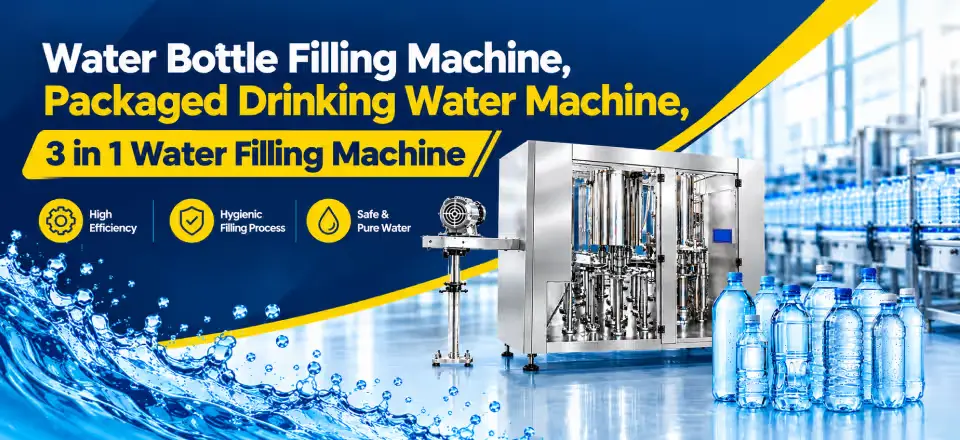
If you are planning a packaged drinking water plant, the rinse-fill-cap machine is the heart of your production floor. It is the machine your customers never see, yet it decides how clean, how consistent and how fast every bottle leaves your plant. In this guide we break down exactly how a rinse-fill-cap water filling machine works, stage by stage, so you can speak confidently with suppliers and choose the right model for your plant anywhere in India.
What Is a Rinse-Fill-Cap Machine?
A rinse-fill-cap machine (often called a “3 in 1” water filling machine) combines three jobs into one compact unit:
- Rinsing the empty PET bottle
- Filling it with treated water
- Capping it with a screw cap
Before these machines became common, many small plants rinsed, filled and capped bottles at separate stations, often with manual handling in between. Every manual touch adds a chance of contamination and slows the line. Combining the three steps in a single enclosed machine solves both problems.
Step 1: Bottle Infeed
Empty PET bottles arrive from the blow moulding section or from bought-in stock. They travel along an air conveyor or a belt conveyor towards the machine. At the infeed, a star wheel or a gripper system picks up each bottle by its neck and spaces the bottles evenly so that every station receives one bottle at a time.
Why it matters: Smooth infeed prevents jams. A machine that is rated at 60 bottles per minute (BPM) can only reach that speed if bottles arrive in a steady, well-spaced flow.
Step 2: Rinsing
In the rinsing station, grippers hold each bottle by its neck and flip it upside down. A nozzle sprays treated water (or, in some plants, ozonated water) into the inverted bottle. The bottle drains for a moment and is then turned upright again.
Rinsing removes dust and particles that may have entered the bottle during storage or transport. Because the bottle is upside down, the rinse water drains out completely, leaving the bottle ready for filling.
Tip: Ask your supplier whether rinse water can be recovered and reused for floor cleaning or other non-product purposes. In water-stressed regions, this can make a real difference to running costs.
Step 3: Filling
The rinsed bottle moves straight to the filling station. Most packaged drinking water machines use gravity filling or level filling:
- The filling valve opens when the bottle is in position.
- Water flows from an overhead tank into the bottle.
- The valve closes when the water reaches the set level.
Level filling gives a consistent visual fill height across every bottle, which customers notice on a retail shelf. Contact parts in this section are typically made of food-grade stainless steel so they do not react with the water and are easy to clean.
What to check: Ask how quickly the machine can be adjusted for different bottle sizes, for example from 500 ml to 1 litre. Faster changeover means less lost production time.
Step 4: Capping
Immediately after filling, the bottle reaches the capping station. Caps are fed from a hopper through a chute that orients every cap the right way up. The capping head picks a cap,
places it on the bottle neck and screws it on with a controlled torque.
Correct torque is important. Too loose, and the bottle leaks or the seal is not tamperevident. Too tight, and customers struggle to open it, or the cap thread is damaged.
Step 5: Outfeed and Further Packing
Sealed bottles exit on an outfeed conveyor. From here, most plants add:
- Inspection (manual or automatic) for fill level and cap position
- Batch coding for date and batch number
- Labelling with a sleeve or sticker label
- Shrink wrapping into multipacks for transport
A complete line is planned so that every downstream machine matches the speed of the rinse-fill-cap unit. There is no point buying a fast filler if your labelling or packing section becomes the bottleneck.
How to Choose the Right Capacity
Civet India builds water filling machines in more than one capacity, including 40 BPM and 60 BPM models. As a rough guide:
- A 40 BPM machine suits new or smaller plants supplying a local market.
- A 60 BPM machine suits growing plants with steady distributor demand, or plants that want headroom for growth.
Work backwards from your expected daily sales, the number of shifts you plan to run, and the bottle sizes you will sell. A supplier who asks you these questions before quoting is a supplier who is trying to fit the machine to your business, not just sell you a model.
Hygiene Features to Look For
Because packaged drinking water is a food product, hygiene is non-negotiable. When comparing machines, look for:
- Stainless steel contact parts that can be cleaned easily
- An enclosed filling zone to reduce airborne contamination
- Smooth surfaces without hidden corners where water can stagnate
- Easy access for daily cleaning and periodic sanitisation
You should also follow the regulations that apply to packaged drinking water in India, including the BIS certification and FSSAI licensing requirements, and confirm the latest
rules with the authorities before you begin.
Common Problems and Simple Fixes
| Problem | Likely cause | What to do |
| Uneven fill levels | Worn valve seals or unstable tank level | Check seals, keep the overhead tank level steady |
| Loose caps | Incorrect torque setting | Recalibrate the capping head |
| Bottle jams at infeed | Uneven bottle supply or wrong change parts | Steady the conveyor feed, check change parts |
| Water spills during filling | Bottle not centred under the valve | Check star wheel alignment |
Regular preventive maintenance and an Annual Maintenance Contract (AMC) keep these issues rare.
Why Choose Civet India
Civet India is an ISO 9001:2015 certified manufacturer of filling, sealing, labelling and packaging machines based in Kolkata, supplying plants across India. With every water filling machine you get:
- Customisation to your bottle size and output
- Installation and operator training at your site
- A 12-month warranty
- 24/7 after-sales support and genuine spare parts
Frequently Asked Questions
Is a rinse-fill-cap machine the same as a 3 in 1 machine?
Yes. Both terms describe a single machine that rinses, fills and caps bottles.
Can one machine handle different bottle sizes?
Usually yes, with change parts. Ask your supplier how long a changeover takes.
Do I need a separate labelling machine?
Yes. Labelling is normally a separate machine placed after the filler.
Ready to Start or Upgrade Your Water Plant?
Talk to our team about the right rinse-fill-cap machine for your plant. Call or WhatsApp
+91 8334957009 or visit civetindia.com to request a quote.