
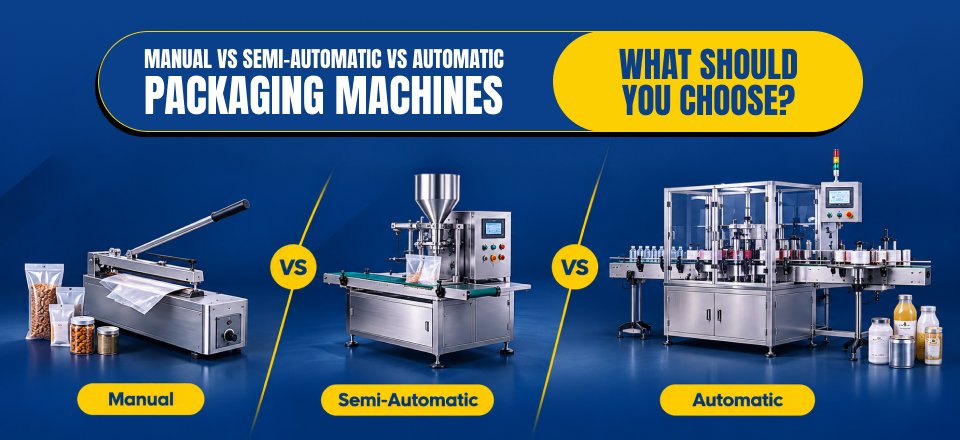
Manual vs Semi-Automatic vs Automatic Packaging Machines: What Should You Choose?
Choosing the right packaging machine is an important decision for any manufacturing business. Whether you manufacture edible oil, beverages, dairy products, food items, chemicals, pharmaceuticals, or...
Choosing the right packaging machine is an important decision for any manufacturing business. Whether you manufacture edible oil, beverages, dairy products, food items, chemicals, pharmaceuticals, or other packaged products, the right level of automation can influence production efficiency, labour requirements, consistency, and future scalability.
But with so many packaging solutions available, one question often comes up:
Should you choose a manual, semi-automatic, or fully automatic packaging machine?
The answer depends on your production volume, product characteristics, budget, workforce, packaging format, and future growth plans.
In this guide, we compare all three options and highlight packaging solutions from CIVET India that can help businesses choose the right level of automation.
What Is a Manual Packaging Machine?
Manual packaging machines require significant operator involvement. The operator may need to position containers, start the filling process, handle capping or sealing, and move finished products to the next stage.
Manual systems can be useful for businesses with smaller production requirements, limited batches, or applications where flexibility is more important than high-speed production.
Key characteristics
- High operator involvement
- Lower initial investment
- Suitable for smaller production volumes
- Flexible for different batches
- Relatively simple operation
- Higher dependence on manual labour
When should you consider a manual machine?
If your business is starting production or handles relatively small batches, a manual packaging solution can be a practical option.
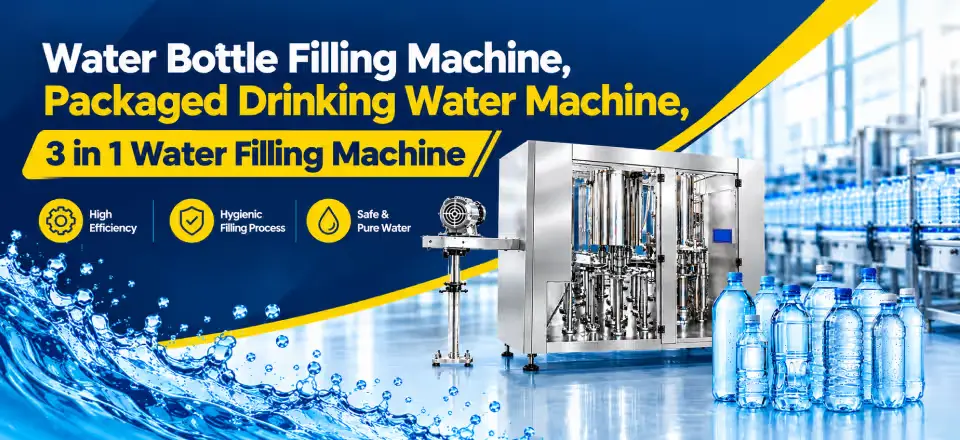
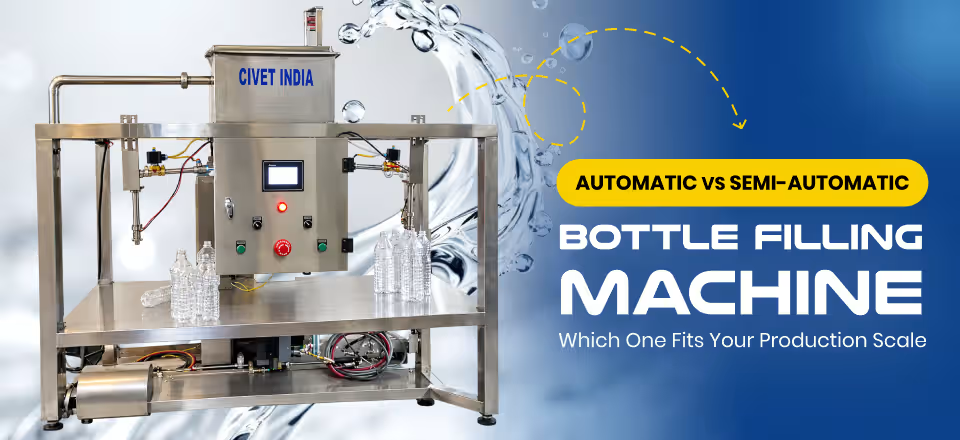
For businesses packaging liquids such as oil, juice, syrup, water, lubricants, or similar products, CIVET India offers a Semi Auto/Manual Bottle Filler for Oil and Free-Flow Liquids, designed for 100 ml to 1000 ml containers.
What Is a Semi-Automatic Packaging Machine?
Semi-automatic packaging machines combine machine-based operations with human involvement.
For example, an operator may position bottles manually while the machine performs the filling operation. Depending on the configuration, additional processes such as capping, sealing, or labeling may also require operator involvement.
This makes semi-automatic machinery a useful middle ground between completely manual packaging and full automation.
Key benefits
- Reduced manual effort
- Better consistency
- Higher productivity than basic manual operations
- Moderate investment
- Suitable for small and medium-scale production
- Can provide a transition toward higher automation
For growing businesses, a semi-automatic machine can provide additional production capacity without immediately requiring a complete automated packaging line.
What Is an Automatic Packaging Machine?
Automatic packaging machines are designed to perform multiple packaging operations with minimal operator intervention.
Depending on the machine configuration, processes such as feeding, filling, capping, sealing, and labeling can be integrated into one continuous production workflow.
For businesses with higher production requirements, automation can help streamline repetitive packaging operations while maintaining consistent processes.
Key benefits
Reduced manual intervention
- Higher production capacity
- Consistent packaging operations
- Better integration between packaging stages
- Reduced dependence on repetitive manual tasks
- Suitable for medium and high-volume production
For example, CIVET India's Automatic Liquid Filling, Capping & Labelling Machine combines three important packaging processes in one continuous inline system. It is available in 4-head and 8-head configurations for 100 ml–1000 ml PET bottles.
Manual vs Semi-Automatic vs Automatic Packaging Machines
| Operator involvement | High | Moderate | Low |
| Initial investment | Generally lower | Moderate | Generally higher |
| Production capacity | Lower | Medium | Higher |
| Process consistency | More operator-dependent | Improved | High when properly configured |
| Labour requirement | Higher | Moderate | Lower for repetitive operations |
| Flexibility | High for small batches | Good | Depends on configuration |
| Production scale | Small | Small to medium | Medium to large |
| Automation level | Low | Medium | High |
1. Consider Your Production Volume
Production volume should be one of the first things you evaluate.
If your production requirement is relatively low, a manual or semi-automatic machine may provide sufficient capacity.
As demand increases, automated equipment can help reduce repetitive manual operations and maintain a more streamlined production process.
For example, CIVET's Automatic Litchi Drink Filling Machine with Unscrambler integrates bottle unscrambling, rinsing, and filling into an automated line. The system is designed for beverage applications and can handle production speeds of up to 120 BPM, depending on configuration.
2. Evaluate Your Budget
Budget is another important consideration.
A manual machine may require a lower initial investment, while semi-automatic and automatic systems generally involve greater investment because they perform more operations with less operator intervention.
However, don't evaluate a machine only by its purchase price.
Consider the total operating picture, including:
- Labour requirements
- Production capacity
- Maintenance
- Energy consumption
- Downtime
- Spare parts
- Future expansion
- Production losses
The objective should be to select a packaging solution that matches your current requirements while also considering your future production plans.
3. Evaluate Labour Requirements
Manual packaging requires more direct operator involvement.
Semi-automatic systems reduce some repetitive tasks, while automatic systems can perform multiple packaging operations with minimal intervention.
For high-volume manufacturing, automation can allow operators to focus more on machine monitoring, quality control, material handling, and other production activities.
4. Consider Filling and Packaging Accuracy
Consistency is especially important when packaging products that require controlled filling volumes or precise labeling.
A properly configured machine can provide more consistent operations than processes that rely heavily on manual handling.
For example, CIVET's Automatic Sticker Labeling Machine uses a stepper-motor-based system and can apply self-adhesive labels at speeds of up to 60 labels per minute, depending on application and configuration.
5. Choose a Machine According to Your Product
Different products require different packaging technologies.
A machine suitable for water may not be the ideal solution for edible oil, syrup, dairy products, sauces, or viscous liquids.
Important considerations include:
- Product viscosity
- Product density
- Foaming characteristics
- Filling temperature
- Container size
- Container shape
- Required filling volume
- Packaging material
- Production speed
For businesses working with edible oil and other viscous liquids, CIVET offers an Automatic Oil Packaging Machine using Form-Fill-Seal technology. The C-LAX series supports 200 ml to 1000 ml pouch formats and is available in different configurations for varying production requirements.
6. Consider the Complete Packaging Line
Sometimes filling is only one part of the packaging process.
Your production line may also require:
Bottle Feeding → Filling → Capping → Sealing → Labeling → Coding → Packing
Instead of purchasing separate equipment without considering compatibility, businesses can evaluate whether multiple packaging stages can be integrated into one production line.
CIVET provides filling, capping, labeling, cup filling and sealing, wrapping, and other packaging automation solutions designed for different industrial applications.
For example, CIVET's Automatic Gluco Cup Filling & Sealing Machine is designed for products such as yogurt, water, ice cream, curd, and juice, with a 4-lane configuration and 50 ml–250 ml cup range.
7. Think About Future Growth
Your current production requirement may not remain the same.
If you expect your business to grow, consider whether your packaging equipment can support increased demand.
For example, a business producing a few hundred units today may eventually require thousands of units per day.
Choosing scalable machinery can help reduce the possibility of replacing your packaging equipment too soon.
When discussing your requirements with a machinery manufacturer, consider sharing:
- Current production volume
- Expected future production
- Product details
- Container size
- Packaging format
- Number of shifts
- Available floor space
This information can help determine the appropriate level of automation.
8. Don't Ignore After-Sales Support
Packaging machinery is a long-term investment.
Installation, commissioning, operator training, preventive maintenance, troubleshooting, spare parts, and technical support can all influence machine performance over time.
CIVET India provides installation support, operator training, production-line integration, maintenance assistance, and technical support as part of its packaging machinery solutions.
Which Packaging Machine Should You Choose?
There isn't one packaging machine that is suitable for every business.
Choose a manual or semi-automatic solution when:
- Your production volume is relatively low
- You handle smaller batches
- You need greater operator flexibility
- Your initial investment needs to remain controlled
- You are testing or launching a product
Consider an automatic solution when:
- Production volume is increasing
- Repetitive manual work is becoming a bottleneck
- Consistent production is important
- You need faster packaging operations
- You want to integrate multiple packaging stages
- You are planning for future production growth
Explore CIVET India's Packaging Machinery Solutions
From semi-automatic bottle fillers to fully automatic filling, capping, labeling, cup filling, oil packaging, shrink wrapping, and flow-wrap machines, CIVET India offers packaging solutions for a wide range of industrial applications.
Explore the complete CIVET India product range:
Whether you're upgrading an existing production line or setting up a new packaging operation, the right machine should be selected based on your product, production volume, packaging format, budget, and future growth requirements.
Need help selecting the right packaging machine?
This version gives CIVET multiple product-page entry points from one educational article, which is useful for internal linking and turning informational traffic into product enquiries.
Explore the complete CIVET India product range:
Whether you're upgrading an existing production line or setting up a new packaging operation, the right machine should be selected based on your product, production volume, packaging format, budget, and future growth requirements.
Need help selecting the right packaging machine?
This version gives CIVET INDIA multiple product-page entry points from one educational article, which is useful for internal linking and turning informational traffic into product enquiries.